

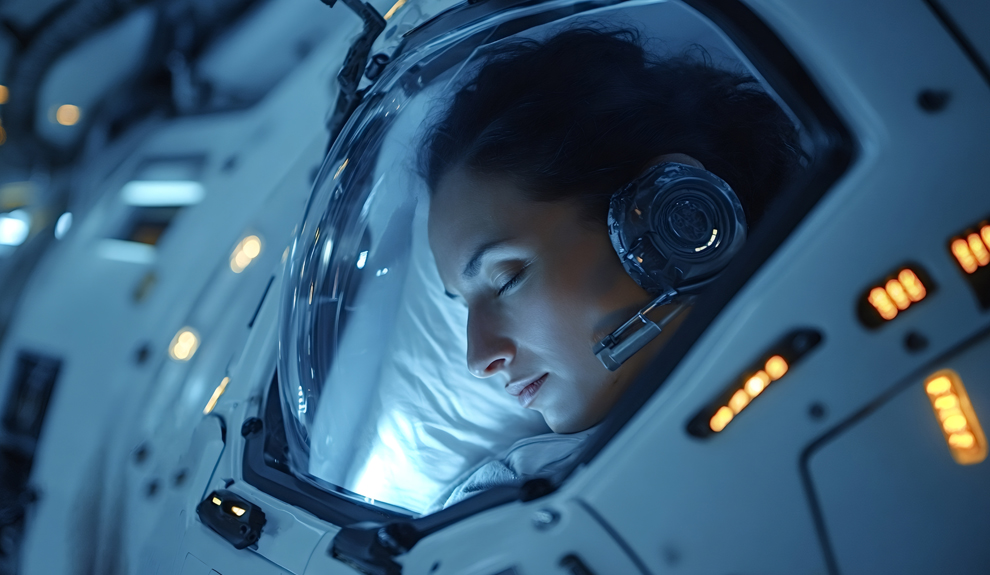
Sleeping in orbit: what astronauts teach us about quality sleep
When we think of space, we often imagine breathtaking views and cutting-edge technology. But one lesser-known aspect is how real space explorers (astronauts) manage to sleep. The challenges they face in orbit offer us valuable lessons for improving our rest here on Earth.
Why is sleeping in space so complicated?
On the International Space Station (ISS), astronauts sleep in sleeping bags strapped to the walls to prevent floating. Their rest is affected by constant noise, fluctuating temperatures, demanding shifts, and artificial light cycles that repeat 16 times a day.
According to NASA's Technical Brief Sleep Accommodations, astronauts sleep on average only 6–6.5 hours (compared to 7 hours on Earth), and their rest is often interrupted by environmental and logistical factors (NASA).
Without the natural day-night cycle, the body’s internal clock becomes unbalanced. To combat this, NASA has developed LED lighting systems that simulate sunrise and sunset, helping to resynchronize circadian rhythms and improve sleep quality (NASA).
Another challenge is sleep monitoring itself. The scientific project Sleep in Orbit introduced miniaturized ear-EEG sensors to record sleep cycles directly in space. These data allow researchers to compare orbital and terrestrial sleep patterns and to develop strategies against micro-awakenings and circadian misalignment (NASA, Planetary.org).
Thermoregulation and Temperature-Regulating Fabrics
One critical issue in orbit is body temperature regulation. Studies show that astronauts’ body temperature can rise by about 1°C even while at rest during long-duration missions (Nature.)
To manage such extreme conditions, advanced fabrics have been developed to intelligently absorb and dissipate heat. Among them is Outlast®, a technology originally created for aerospace applications: a material embedded with Phase Change Material (PCM) microcapsules that store, absorb, and release heat based on the surrounding environment.
Today, these fabrics are no longer limited to space missions — they are now used on Earth to improve thermal comfort during sleep, creating a stable microclimate and promoting deeper, more continuous rest.
What can this teach us about sleep at home?
The experience of astronauts reminds us that sleep is a delicate process, affected by posture, light, temperature and consistency. Even without being in orbit, we can apply these same principles to improve our rest:
Respect circadian rhythms by limiting evening exposure to artificial light;
Sleep in a thermally balanced room, ideally between 17 °C and 20 °C;
Use fabrics that support dynamic thermoregulation, like Outlast®, to keep body temperature steady throughout the night.
On World Space Week, one thing is clear: space-born research continues to bring real benefits down to Earth.
Improving our sleep means not only resting better, but living with more clarity and energy — essential qualities to tackle each day as a small, great mission.